
The ComplEAT Kitchen

Welcome to the Tip of the Tongue Newsletter! Thanks to new subscribers and regular readers, especially those of youwho are recommending Tip of the Tongue to their friends and subscribers!
On Sunday there is always this free newsletter , The ComplEAT Kitchen, about what is going on in my food and drink world, at SoFAB, at the SoFAB Research Center at Nunez Community College, and out in the world. Tip of the Tongue, my podcast, appears on Monday. This Monday I speak with local entrepreneur and Captain Jason “Pip” Pipinger about his bespoke tour business in the New Orleans area. And one or two more print issues appear during the week for paid subscribers.
Cooking: I am not only preparing for the big Creole dinner this July in Wisconsin, I am cooking for a family friend whose wife has just been hospitalized. I decided to make a lasagne. And while I am at it I made extra sauce so that I could make an eggplant parmesan for our house for later and also a bit extra for leftover bits. There is nothing like a hearty tomato sauce to absorb a half of a sausage, chopped up, that one leftover chicken thigh, and/or a few leftover shrimp. They somehow seem compatible when thrown into a tomato sauce. I have been chopping and sauteing. Now that it is simmering, I am realizing how good it all smells.
Reading: I have been reading a new book by Erin O’Brien, Dig In! : Over 100 Easy, Delicious, and Stree-Free recipes to Make on Repeat. This is a cookbook for everyday home cooking. You know, the kind where you must prepare meals, especially family meals, day after day. It is both a joy and a chore. Sometimes the chore pokes its head up and other times you can hum your way through getting ready for the family meal.
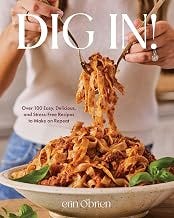
This book is full of thoughtful and inspired dishes for everyday. Having this book and using it to do a bit of planning, especially when your own go-to recipes are feeling shopworn, will really be a shot in your arm. It will make the drudgery seem something from a distant past.
For example, Spice-Rubbed Fish Tacos with Cilantro Cabbage Slaw, can be made in less than an hour. The small changes that she makes from traditional fish tacos - like baking the fish instead of frying it - help with clean-up as well as with prep. It is this thoughtfulness of the recipes that makes the book special.
Kale & Lentil Soup with Parm Crostini is another hearty meal that will please and satisfy a family. It can be made in an hour and it will feel very special. Being able to use a staple like lentils means that you can make this on the spur of the moment, even if you have to substitute other greens for the kale. It will still be hearty and flavorful.
The book contains menus for special events and a section with flavorful cocktails. The desserts are serious and could be eaten for more than one meal. There are so many cookbooks that are being published these days, often by people like Erin O’Brien with millions of followers. This book is something that will appeal to more than her followers. This one is a book for everyone who makes dinner. I recommend it.
Watching: Please join us on July 9 at 7 pm central.

Gardening: Now that the front that caused the daily rain has passed, we find ourselves in a heat dome. I have finally figured out a very low maintenance plant to fill a bed designed for foundation planting around the house. Elephant ears. The low light that this bed gets on the northwest side of the house will work very well with elephant ears. And these plants will survive deluge and will return after a freeze. This will be a good project that I can work on bits at a time, but that will result in something useful and positive.
Writing: I am madly trying to finish the Marcelle Bienvenu manuscript. I am also trying to line up the articles that are due so that I can spend most of my time with my granddaughters. I have a number of recipes to write and I need to photograph them. Busy, busy.
Culinary Research Center at Nunez Community College: With all of the talk about the anniversary of the founding of America, I have anniversary celebrations on the brain. I found in the pamphlet collection of the Culinary Research Center at Nunez Community College an interesting 100th anniversary recipe booklet for Wanzer’s, a Chicago-based dairy. The pamphlet, aptly named Wanzer’s 100th Anniversary Recipe Book: 100 Tested Kitchen Adventures, celebrates the founding of Sidney Wanzer & Sons in 1857. The pamphlet from 1957 was about Kitchen Adventures, which was the name of the recipe folder that was included with the monthly invoice of regular Wanzer’s customers since 1948. Of course the pamphlet includes some sort of dairy product – at least one – in each of the recipes.
Wanzer Milk began with an entrepreneur, Sidney Wanzer, began to bring milk from the countryside to 20 year old Chicago. He sold it door to door. For the city dwellers of Chicago, pastured cows produced a better milk than milk from the city dairies, where the cows were fed the waste from distilleries. The Wanzer family landed in America in 1642 in New Amsterdam, now New York. From there the family moved to Vermont , where young Sidney was born in 1834. His father decided to move to Chicago and brought his cattle with them. They began dairying in 1839 in Illinois. He began working a “route” for a company that sold country milk in Chicago. He saved his money and eventually started his own route. Sidney lived in Chicago and the dairy farmers sent him milk via train, where he removed the canisters of milk to his wagon. He had graduated pouring cans which allowed him to measure the milk and pour it into the pitchers of the households as he developed his route.
Wanzer’s business grew as more households rejected the milk from the city dairies. Sidney’s business survived the Chicago fire in 1871, by rebuilding after seeing his business go up in smoke. He redirected his business to the still standing south side of the city.
Sidney included his sons in his business, now Sidney Wanzer & Sons. Scientific dairying practices were introduced and the Wanzer kept up with it. Soon the glass milk bottle was adopted, making it unnecessary to pour milk at each stop along the route. These bottles were adopted by Wanzer’s in 1894. They adopted mechanical refrigeration as soon as they could. In 1898 they were the first Chicago dairy to pasteurize their milk.
In 1933 scientists developed irradiation to enrich the vitamin D in milk, and in 1940 Wanzer began to apply this technology to their milk as well as homogenization of milk. Wanzer’s was sold in 1969 to Southland Corporation. And it no longer exists, but these pamphlets remind us of how the company supplied the city of Chicago.
Here is Classic Vichyssoise from the booklet:
Serves 8
4 leeks
2 medium onions
¼ cup butter
5 potatoes
1 quart chicken broth
2 pints Wanzer half & half
½ pint Wanzer Special Heavy Cream
2 tablespoons chopped chives
Do it like this: Dice finely the leeks (white parts only) and onions and brown very lightly in butter. Add peeled, diced potatoes and chicken broth. Boil gently 35 minutes, then rub through fine sieve or strainer.
Add Wanzer’s 50-50 (that’s our famous blend of half milk and half cream), salt to taste, and bring just to a boil. Now strain again through fine strainer and cool the soup. When cold, add Special Heave Cream and chopped chives. Chill 2 or 3 hours and serve very cold. Enough for 8. This delightful meal starter is perfect on many occasions and one of our favorite follow-ups is barbecued chicken, a garden salad, bread sticks, and a dessert of pineapple sherbet with hot coffee.
We look forward to seeing you at the Research Center whether you are looking for a recipe or need information about wine or cocktail. We are open to the public and hope to see you soon. We are a great place to volunteer. Whether you, your service organization or a high school student seeking service hours, just get in touch with me at lizwillia@gmail.com. And if you have books or ephemera or menus to donate, please get in touch.