

ComplEAT Kitchen

Welcome to the Tip of the Tongue Newsletter! Thanks to new subscribers and regular readers, especially those of youwho are recommending Tip of the Tongue to their friends and subscribers!
On Sunday there is always this free newsletter , The ComplEAT Kitchen, about what is going on in my food and drink world, at SoFAB, at the SoFAB Research Center at Nunez Community College, and out in the world. Tip of the Tongue, my podcast, appears on Monday. This Monday I speak with Brian Choi , CEO of the Food Institute about the recent acquisition of largest food podcast network, HRN, by the Food Institute. And one or two more print issues appear during the week for paid subscribers.
Cooking: Last week was so insane that we ate down everything that I prepare as a pantry item for eating. We ate up all the mayonnaise, all the hummus, all the bread (including extra loaves in the freezer), all the catsup, all the hard boiled eggs, and tzatziki. We also finished up all of the premade spice mixes so we essentially have to rebuild all of this list so that we can eat this week.
I spent yesterday and this morning mixing and cooking. I think that we are caught up. I am definitely not sorry that we have to make all of these things - they have no salt (important in our house), and they are fresh and without preservatives. I believe that our health is improved by this little effort. As we grow older, our bodies can still refresh themselves, but we might as well help the process along by not piling additives and extra salt into our bodies to save a little time.
But it was an opportunity to see how many things we had replaced with home made. We probably save some $$ too, but not really that much. It is health and flavor, not money that makes it worth while.
As we are making an herb garden, I was digging up other plants in the space and moving them. One thing that I moved was a next of tumeric. With the fresh tumeric added to the hummus - made it a golden yellow - it was a new taste. I liked it.
2 drained and rinsed cans of chickpeas
1 teaspoon baking soda
1 cup tahini
4 tablespoons fresh lemon juice
1/2 cup olive oil
1 tablespoons ground cumin (or more)
1 or 2 1-inch tumeric tubors
4 or 5 cloves garlic, peeled
Chopped parsley
Paprika - smoked or sweet
Place the drained garbanzo beans in a pot with the baking soda. Add water to fully cover the beans. Cook for 15 minutes. Drain and rinse. Cool for 15 minutes.
Place the beans and all of the ingredients except the parsley and paprika into the bowl of a food processor. Process for 10 minutes or so until it is creamy and fluffy. Place the hummus on a platter, for serving right away. Make a dip in the hummus and place a bit more olive oil in the depression and garnish with chopped parsley and paprika.
If not serving right away, place in a covered container and refrigerate until ready to serve.
Listening: Lately I have been listening to lots of podcasts on my walks. I am trying to put together interesting podcasts which will teach me a lot. My favorite is Gastropod. I like the Sporkful, Splendid Table, and Milk Street. These are sort of the regulars. I am looking to find more - besides Tip of the Tongue - to listen to regularly that might be quirky and less slickly engineered. I am working on it. I hope that have a good list for next week.
I am also going through all of the Heritage Radio Network (HRN) podcasts since I am now on the network, to really see who my companions on the network are.

Reading: I have written about my interest in alphabets and languages and dictionaries. That interest has led me to begin reading Genes, Peoples, and Languages by Luigi Luca Cavalli-Sforza. He is a geneticist and this book examines the way travel and liminal areas help to transfer words from one language to another. He states very conclusively that there is no way to explain racial discrimination and ideas about race with genetic terms. But he does see how geography and isolation can make people develop cultural practices, including language, that we may associate with a particular people. I am not finished with the book, which was published in 2000. But it addresses so many issues that are floating around on the internet in our rather fractious time, and says that language may be a better way to group people than genetically or racially.
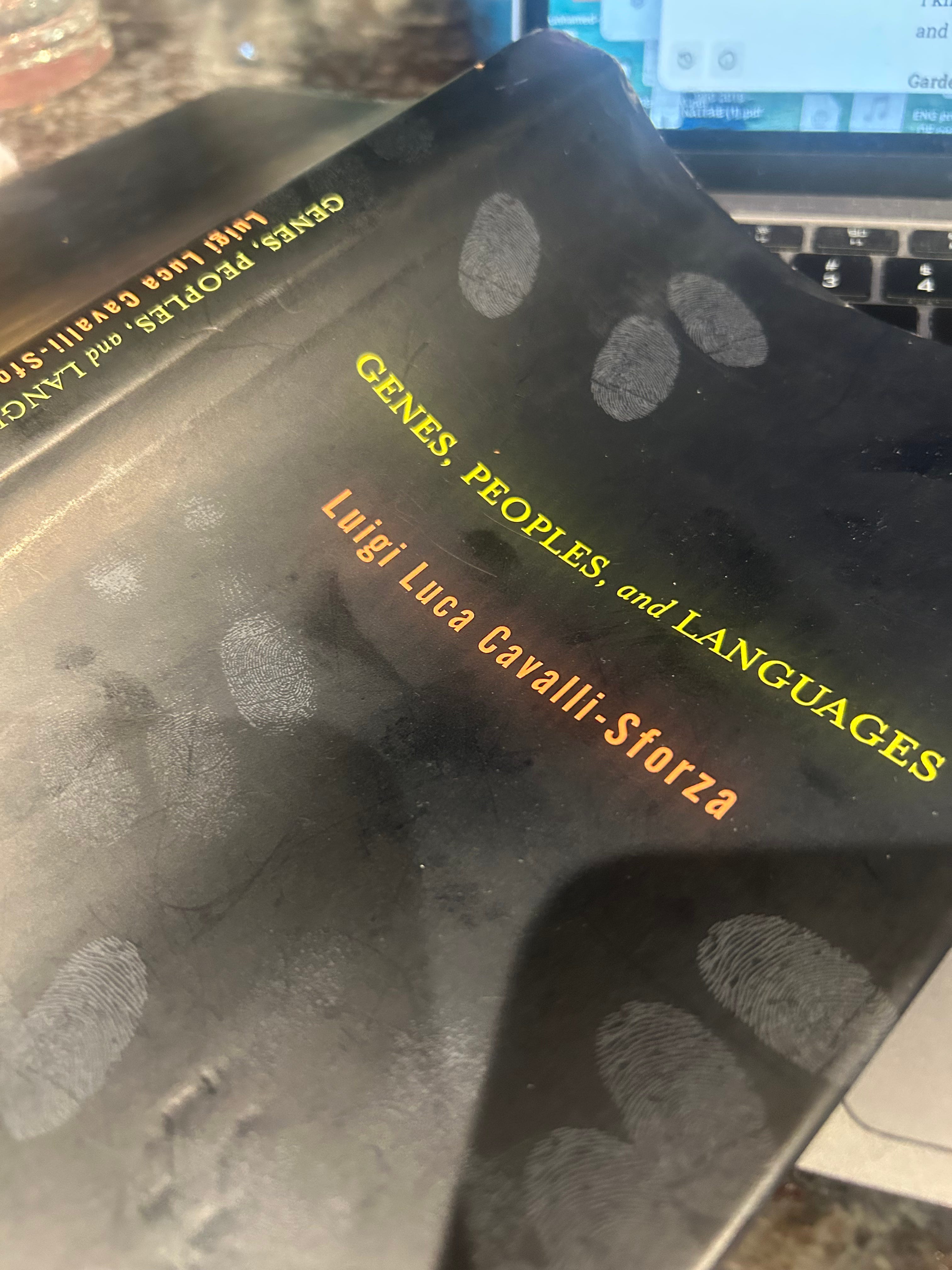
I love the fingerprints as a part of the cover art.
I knew that language was important. I think alphabet borrowing and language and ideas are just fascinating. I’ll share more as I finish the book.
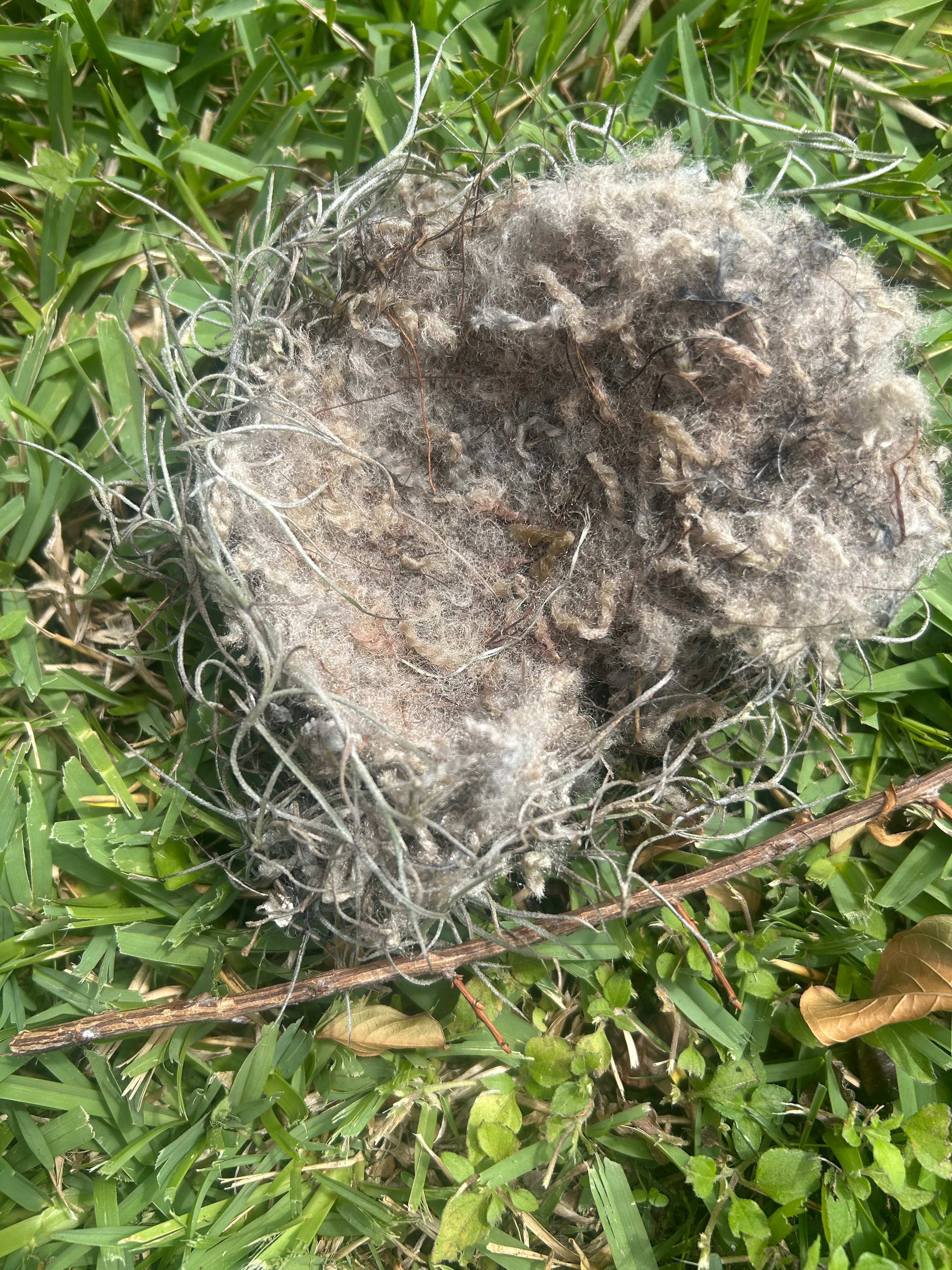
Gardening: I have moved my office. Now I look out on my garden. I watched a squirrel today, after a brief rain, run into the garden and begin eating the bits of vegetables that I had spread on the grass. I love feeding those critters. I found an empty nest that was made with Spanish moss that had been stolen from the moss on my oak tree. The nest seems to have been used and abandoned. How exciting!
News from the SoFAB Culinary Research Center at Nunez Community College: I was digging through the stacks at the SoFAB Culinary Research Center at Nunez Community College, when I came upon a first edition of The Union Square Café Cookbook by Danny Meyer – famous restaurateur and founder of Shake Shack – and famous chef, Michael Romano. Danny Meyer tried to eliminate tipping at the Union Square Café in 2015. He called it a “hospitality included” model, but he abandoned his experiment with the onset of the lockdowns of the COVID epidemic. Meyer also has written a book about hospitality called Setting the Table: The Transforming Power of Hospitality in Business. In the book, Meyer discussing enlightened hospitality, as well as his own journey in the hospitality business.
Michael Romano was the James Beard Foundation award-winning chef at Union Square Café and was awarded three stars by the New York Times. And as a part of the Union Square Hospitality Group, he was involved with Gramercy Tavern, Blue Smoke, Jazz Standard, Shake Shack, Maialino, and The Modern. He won the competition show on the Food Network, Sweet Genius in November 2013. He has written other cookbooks such as Second Helpings from the Union Square Café.
But this book was written in 1994 at an early point in their careers. The book is full of classic recipes from around the world. Ribollita is a flexible Italian soup made with beans and greens as a base with whatever additional vegetables you may have on hand. See the basic recipe below, you get the outline. You can use your imagination and make this soup your own. You can nail down your personal recipe or make it differently every time.
Ribollita
Serves 6 to 8
1 cup dried cannellini or Great Northern beans
2 teaspoons kosher salt
4 tablespoons olive oil
2 cups diced zucchini (1 medium)
1 ½ cups dice onions
2/3 cup diced celery
½ cup scrubbed and diced carrots
¼ pound pancetta, dice (1 cup)
2 tablespoons minced garlic
½ head savoy cabbage, washed and cut into 1-inch pieces
2 tomatoes, peeled, seeded, and chopped
½ cup chopped basil
2 cups cleaned spinach leaves
¼ teaspoon freshly ground black pepper
4 cups cubed day-old sourdough bread
½ cup grated Pecorino Romano
4 tablespoons extra-virgin olive oil
1. Rinse and cover the beans with cold water and soak overnight.
2. Drain the beans and place them in a saucepan with 8 cups cold water. Cook, covered, for 1 hour. Add 1 teaspoon of the salt and continue cooking for an additional 30 minutes, or until the beans are tender. Set the beans aside with their liquid.
3. Over a medium flame, heat the olive oil in a large soup pot. Over medium heat, saute the zucchini, onions, celery, carrots, pancetta, and garlic until softened, about 10 minutes. Add the cabbage, tomatoes, basil, and spinach. Season with the remaining 1 teaspoon salt and pepper. Conintue to cook, stirring occasionally, for another 10 minutes.
4. Strain the beans, reserving their cooking liquid. Puree half the beans in a food processor. Add the pureed beans, the whole beans, and their cooking liquid (8 cups) to the soup pot and simmer over low heat for 20 minutes. If you don’t have enough cooking liquid, add water to make up the difference.
5. Add the diced sourdough bread to the soup and cook for 10 more minutes. Adjust the seasoning. Serve with the Pecorino Romano and a drizzle of extra-virgin olive oil.
If you would like to make a donation of books or join the Friends of the SoFAB Culinary Research Center, please get in touch with me. My email is lizwillia@gmail.com. Also get in touch if you would like a tour of the Research Center or if you would like to volunteer.
Thanks to all of you who have visited, donated, and volunteered at the Research Center. We are trying to build an academic and intellectual engine for economic development in St. Bernard Parish to stand alongside the wonderful food and industrial aspects of the economy. Interested in becoming a Friend of the Research Center? Just let us know.

If you would like to make a donation of books or join the Friends of the SoFAB Culinary Research Center, please get in touch with me. My email is lizwillia@gmail.com. Also get in touch if you would like a tour of the Research Center or if you would like to volunteer.
Thanks to all of you who have visited, donated, and volunteered at the Research Center, with a special thanks to Chef Ruth Varisco. Chef Ruth has donated part of her collection of culinary books, which will form the Chef Ruth Varisco Collection. If you would like to make a donation of a book, or papers or other ephemera or of money in honor of Chef Ruth, just let me know. Chef Ruth has been a part of sharing her passion for cooking with students at Nunez Community College for decades. Join us in honoring her.

Reach me at lizwillia@gmail.com or I’ll be giving a tour at the Southern Food & Beverage Museum on Friday at 3:30 if you want to join the tour.